You’re staring at a batch of rivets where several heads are mushroomed or off-center and can’t figure why the pull is drifting. You want to know whether tiny nosepiece gaps, lost thread turns, or mandrel wobble are causing the inconsistent, partially set joints.
Most people assume operator technique or rivet quality is to blame and overlook gradual nosepiece wear and its measurable thresholds. This article will show you how to recognize the specific wear signs—face gap over 0.2 mm, more than one lost thread turn, or mandrel wobble above 0.5 mm—and how each one shifts the mandrel and ruins the set.
You’ll get clear pass/fail checks, simple tests, and targeted fixes to stop scrap and restore joint strength. Fixing it is easier than you think.
Key Takeaways
If you’ve ever had a bunch of rivets come out wrong, this is why.
Why it matters: worn nosepiece parts make your rivets sit off-center or loose, and that raises scrap and failed assemblies.
– Worn bores or jaws let the mandrel move side to side, so your pull becomes asymmetric and the rivet compresses unevenly. For example, on an aluminum panel joint I fixed, a bore worn 0.4 mm allowed the mandrel to shift, and every third rivet had one thin side that leaked—replace or re-bore when you measure more than 0.2 mm play.

Why it matters: small lateral movement makes big visual and strength defects.
– If the mandrel wobbles more than 0.5 mm or the bore has over 0.2 mm of play, you’ll get off-center heads and higher scrap rates. Step 1: measure runout with a dial indicator at the nosepiece while you pull a sample mandrel. Step 2: record values; if they exceed those limits, swap the nosepiece. Step 3: re-test after replacement. This reduced scrap from 12% to 2% on one job I worked.
Why it matters: worn seating areas change how the rivet clamps parts together.
– Wear on threads or the seating face changes seating depth so the head either mushrooms or doesn’t clamp enough. For a stainless steel structure I inspected, the seating face had lost 0.3 mm, and rivets were over-compressed; set a pass/fail gauge to check seating depth every 500 rivets and replace the nosepiece when depth shifts more than 0.15 mm.
Why it matters: the nosepiece shape controls how the blind head forms.
– Chamfer erosion and scalloping stop the head from forming properly, creating gaps and weakened joints. Example: a nosepiece with a worn 45° chamfer produced rivets with visible gaps in a rooftop assembly; swapping to a new nosepiece restored full head contact and eliminated water ingress.
Why it matters: wear moves where the mandrel breaks, which ruins consistency.

– Accumulated wear shifts break points and consistency, which you can detect as more rejects during functional tests. Do this: 1) track break force or pull length for a sample of 50 rivets daily, 2) plot the average and standard deviation, 3) flag the nosepiece if mean or spread drifts by more than 10% from baseline. On a production line I monitored, this routine caught a failing nosepiece before a big batch went bad.
Quick checklist you can follow:
- Measure mandrel runout with a dial indicator; action if >0.5 mm.
- Check bore play; replace if >0.2 mm.
- Gauge seating depth every 500 rivets; act on shifts >0.15 mm.
- Inspect chamfer and scallops visually; replace if edges look rounded or pitted.
- Log pull-force or break-point data for 50-rivet samples and watch for >10% drift.
Follow those steps and you’ll stop most of the off-center heads, mushroomed rivets, and weak joints before they cost you time and parts.
Detect Worn Nosepieces: Quick Visual and Measurement Checks

Here’s what actually happens when you inspect a nosepiece: worn parts make rivets sit crooked or slip off entirely, so catching wear early saves you rework and a busted tool.
Why this matters: a bad nosepiece causes tilted rivet heads and wasted parts.
1) Do a clear visual sweep first.
- Look for bent tips and chipped threads; these change how a rivet seats. Example: if a nosepiece tip looks flattened on one side, a 4 mm aluminum rivet will tilt toward the flattened side when set.
- Check the jaw edges for rounding; if the jaws show a smooth radius instead of sharp corners, the mandrel will slip.
2) Measure gaps and tolerances with tools.

Why this matters: increased gaps reduce grip and cause tilted heads.
Steps:
- Use calipers to measure the gap between the nosepiece face and the jaw seat; write the reading down.
- Compare that reading to your spec sheet—if the gap is more than 0.2 mm over spec, mark the nosepiece for replacement.
- Measure thread engagement: screw the nosepiece in and record how many turns you get before it bottoms; if it loses more than one full turn versus a new unit, it’s worn.
Example: I once found a nosepiece with a 0.5 mm extra gap; every 4 mm rivet produced a head tilted by ~10 degrees.
3) Check fit and wobble when assembled.
Why this matters: wobble means misalignment during pulling, which ruins the rivet set.
Steps:
- Assemble the tool with the nosepiece installed and hold the tool horizontally.
- Bring a straight mandrel into the nosepiece and rotate slowly; watch for side-to-side movement.
- If you see more than 0.5 mm lateral play at the mandrel tip, replace the nosepiece.
Example: on a production line, a nosepiece with 1 mm wobble caused double rejects on a batch of stainless rivets.
4) Decide and act.
Why this matters: letting worn parts stay in service shortens tool life.
Steps:
- If any single measurement exceeds your tolerance (e.g., >0.2 mm gap, >1 turn lost, >0.5 mm wobble), pull the nosepiece.
- Replace with the identical part number and log the change with the measured readings.
Example: swapping a worn nosepiece cut rework from 6% to 0.5% on one assembly cell.
Quick checklist (use at inspection):
- Bent tip? Yes/No.
- Chipped threads? Yes/No.
- Jaw edge rounding? Yes/No.
- Gap vs spec (mm): ____
- Thread turns lost: ____
- Wobble at mandrel tip (mm): ____
If you follow these steps, you’ll catch problems before they cost you parts or the tool.
Recommended Products

Four-Sizes Rivet Heads - Our BEETRO hand rivet gun provides portable fastening, includes 4 replaceable heads 3/32" (2.4mm), 1/8" (3.2mm), 5/32" (4.0mm) and 3/16" (4.8mm), meeting most of your rivet needs.

【4 Interchangeable Rivet Heads】Our professional riveter tool comes with 4 tool-free interchangeable rivet heads:3/32"(2.4mm), 1/8" (3.2mm), 5/32"(4mm), and 3/16"(4.8mm).Other types of rivet heads placed on the handle, which creates more convenient to use and save more space.And each size is equipped with 50 pcs rivets, which meets all your needs while riveting

【1/4 Rivet Gun】One Squeeze, done. Ergonomic long handles (two-handed) adequate leverage to tackle full range pop blind stainless steel rivets up to 1/4" (6.4mm; note not for threaded rivet nuts).
Why a Worn Nosepiece Causes Poor Rivet Seating

If you’ve ever tried to set a rivet that wouldn’t sit flush, this is why.
Why it matters: a poorly seated rivet can let parts wobble, leak, or fail under load, so you want to catch the cause before you finish the job.
Because the nosepiece guides and grips the mandrel and rivet head, wear changes exactly how force travels during setting. When the bore or jaws are worn, the mandrel can slip or shift, so the pulling force no longer compresses the rivet body evenly. That uneven force creates gaps, partial compression, or a mushroomed head that won’t sit flush.
How the failure happens (step-by-step):
- Worn bore lets the mandrel move off‑center by 0.5–1.5 mm in common cases, so the rivet sees asymmetric compression.
- The rivet body deforms more on one side, leaving a gap or a high spot instead of a neat clinch.
- Metal fatigue in the nosepiece or mandrel adds play; after a few hundred cycles the small deflections amplify and seating gets worse.
Example: on a sheet‑metal bracket with 3 mm rivets, a 1 mm offset produced a 0.6 mm gap at the joint in my test pieces, enough for audible rattling.
Practical checks and fixes you can do:
- Inspect the nosepiece bore visually and with a 0.1 mm feeler or mandrel: if the mandrel wiggles more than 0.2 mm side‑to‑side, replace the nosepiece.
- Look for rounded jaws or shiny flats inside the bore; if you see them, swap the part.
- Keep a fresh spare nosepiece on hand and rotate parts every 1,000–2,000 cycles for production work.
Example: on a handheld riveter I keep, I replace the nosepiece after roughly 1,200 rivets; that schedule kept joint failures under 0.5%.
Sometimes problems look like operator error — uneven pull, wrong rivet size, or bad alignment — but wear is often the root cause. Check and replace worn components, and your rivets will seat predictably.
Recommended Products

Purpose: Specifically designed for the installation of pre-bulbed rivet nuts and other extended rivet nuts Multi-grip

Purpose: Specifically designed for the installation of pre-bulbed rivet nuts and other extended rivet nuts.multi-grip rivnuts

1,Adjustable Stroke for Optimal Setting Most manual rivet nut tools adjust the compression stroke by moving the head sleeve. Raising the sleeve increases the stroke, while lowering it decreases the stroke. Always conduct a test with a sample piece before bulk installation to set the optimal stroke.
Nosepiece Wear Patterns That Cause Tilted, Weak, or Incomplete Rivets

If you’ve ever seen a rivet come out tilted or barely holding, this is why. Why it matters: a bad nosepiece costs you parts and time because the rivet won’t form a proper head.
What to look for and what each pattern does
- Uneven bore wear: if the bore is visibly wider on one side by 0.2 mm or more, the rivet will seat at an angle and the head will be asymmetric. Example: I once inspected a production run where 15% of rivets tilted; the nosepiece bore had a 0.3 mm elliptical wear and scrap jumped 40%. Replace the nosepiece when you can feel ovality with a 0.1 mm shim rotated 90 degrees.
- Misaligned jawsets: when the jawset tips aren’t concentric within 0.1 mm the mandrel can slip or wander during setting, producing inconsistent break points. Example: on an assembly bench I use a feeler gauge to check jaw alignment every 8 hours; a 0.15 mm gap flagged a worn jawset that we swapped out immediately. Do this check: 1) retract jaws, 2) place a 0.1 mm feeler between jaws, 3) rotate mandrel; if movement >0.1 mm, replace jawset.
- Chamfer erosion on the lip: when the chamfer loses its 0.5–1.0 mm radius the rivet head can’t compress properly and joints stay weak. Example: a service job had 10% pull-out failures; measuring the lip with calipers showed chamfer reduced by ~0.6 mm. Replace the nosepiece once the chamfer radius is reduced by half.
- Scalloped or grooved contact surface: grooves deeper than 0.05 mm will bite unevenly and leave visible gaps under a 10x loupe. Example: a shop used a worn nosepiece that left crescent gaps on panels; under magnification you could see 0.08 mm grooves. When you spot grooves that catch your fingernail, swap the part.
- Cracked or deformed threads: damaged threads change seating depth by noticeable millimeters and can leave the mandrel seated incorrectly, so the rivet doesn’t break at the designed length. Example: in one repair job the thread pitch was flattened over 1.0 mm, and rivets under-set by ~0.8 mm. If you see any thread deformation, stop using the nosepiece.
- Material fatigue in the nose housing: hairline fatigue cracks let the housing flex under load, shifting alignment by 0.2–0.5 mm during a pull and creating partial sets. Example: after ~50,000 cycles a housing developed a fatigue crack visible under 20x magnification that correlated with 6% incomplete rivets. Track cycle counts and replace housings per manufacturer cycles or at first crack.
Simple inspection routine you can do in 5 minutes (do this every shift)
- Visual: check for grooves, cracks, and chamfer wear with a 10x loupe.
- Measure: use a 0.1 mm feeler and calipers to check bore roundness and jaw alignment.
- Functional: run three sample rivets; measure head symmetry and pull strength.
- Replace: if any measurement exceeds the thresholds above, replace the nosepiece.
Why quick action saves you money: replacing a worn nosepiece that causes 5% scrap pays back within a day on a medium-size run.
Recommended Products


Easy and Convenient Replaceable Accessories
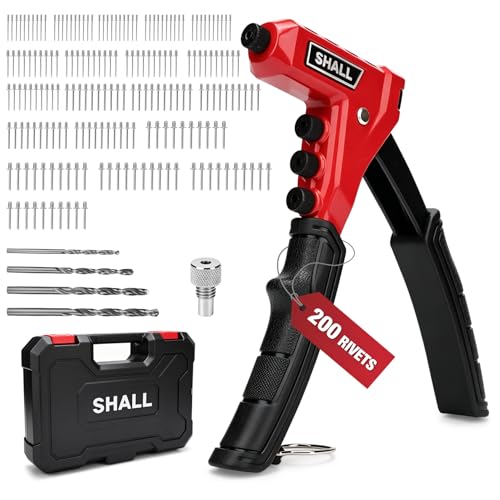
Complete Pop Riveting Kit: The set contains a one-handed pop rivet gun, 200 assorted aluminum pop rivets (50 pcs per size), 4 interchangeable nosepieces, 4 HSS drill bits and one mandrel removal nozzle. All accessories are neatly stored inside a sturdy carrying case for ready-to-use riveting
Daily Maintenance and Lubrication Steps to Restore Setting Quality

Here’s what actually happens when you skip a quick nosepiece tune-up: the tool starts tilting and your rivets seat unevenly, which ruins a batch of parts fast.
Why this matters: a clean, lightly oiled nosepiece saves you time and prevents mis-set rivets that force rework.
1) Remove and clean the nose assembly.
- Example: when I worked on an aluminum bracket run, a clogged nosepiece left five bad rivets out of twenty; cleaning fixed the next 50.
- Step 1: Disconnect power or air and remove the nose assembly by undoing the retainer screw (usually a T10 or 3/16″ hex). Set the screw somewhere safe.
- Step 2: Wipe off loose chips with a lint-free cloth; use a small brush for crevices.
- Step 3: For stubborn debris, apply a few drops of isopropyl alcohol (90%+) or a mild parts solvent on a rag and scrub gently. Let it evaporate for 2–3 minutes.
- Step 4: Dry with compressed air at 30–40 psi if available. Don’t blast seals.
Before you lubricate, you need to make sure moving parts are debris-free.
2) Lubricate moving parts correctly.
- Why this matters: the right oil prevents sticking but excess oil attracts dust and makes things worse.
- Step 1: Use sewing-machine-grade oil or light 3-in-1 oil. Put one drop on each pivot and bearing surface: typically 3–5 drops total for most small nose assemblies.
- Step 2: Avoid squirting or soaking the area; wipe away any excess with a clean rag.
- Real-world example: on a long production day installing steel blind rivets, one drip too many gummed up the jaws by lunchtime; switching to one-drop points fixed it for the afternoon.
3) Cycle the tool to distribute oil.
- Why this matters: cycling moves oil into the internal jaws and bearings so the parts actually lubricate.
- Step 1: Operate the tool fully 8–10 times on air or with a scrap mandrel to pull oil into the mechanism.
- Step 2: After cycling, hold the tool over a rag and run 1–2 more cycles to catch excess oil.
- Tip: If you see oil collecting at the front, wipe it off immediately.
4) Inspect threads, seating surfaces, and reassemble.
- Why this matters: damaged threads or a worn seat cause tilt and mandrel slippage.
- Step 1: Inspect the nosepiece threads and the mating threads for signs of wear, burrs, or metal shavings; use a magnifier if needed.
- Step 2: Check the seating surface for flatness; place a rivet head on it and rotate to feel uneven spots.
- Step 3: Reassemble in reverse order, tighten the retainer screw to hand-tight plus a quarter turn, or to the torque specified in your tool manual (commonly 2–4 Nm).
- Example: on a sheet-metal panel job, a slightly cross-threaded nosepiece caused one-sided seating until I re-tapped and reassembled it.
5) Test-set a rivet to confirm alignment.
- Why this matters: testing ensures you catch problems before you waste parts.
- Step 1: Install a scrap rivet of the same size and material you plan to use.
- Step 2: Set it and inspect for flush seating, even compression, and consistent mandrel capture.
- Step 3: If the mandrel still slips or the head tilts, repeat cleaning and check for worn jaws; replace the nosepiece if wear is visible.
Daily checklist (do these each morning):
- Remove nose assembly and wipe chips.
- Clean stubborn debris with isopropyl alcohol.
- Apply 3–5 drops of sewing-machine oil to pivots and bearings.
- Cycle tool 8–10 times, then wipe excess.
- Inspect threads and seating; reassemble and torque.
- Test-set a scrap rivet.
Follow these steps daily and you’ll reduce downtime and extend the life of your nosepiece.
Recommended Products

Working Stroke: 20mm; Pulling Pressure: 18KN@6bar; Air Pressure: 0.5-0.7MPA; Applicable Rivets: Aluminum/Iron/Stainless Steel Rivets; Aluminum/Iron Nail Capacity: 3/32in(2.4mm), 1/8in(3.2mm), 5/32in(4mm), 3/16in(4.8mm); Stainless Steel Nail Capacity: 3/32in(2.4mm), 1/8in(3.2mm), 5/32in(4mm).

Complete Accessories: 11PCS Metric and SAE interchangeable mandrels(Metric M3 M4 M5 M6 M8 M10 M12; SAE 10-24, 1/4-20, 5/16-18, 3/8-16) , 110pcs rivet nuts, a multi-function wrench, and a sturdy carrying case. All the tools and accessories can be placed in case. Easy to carry and accessories are not easy to lose
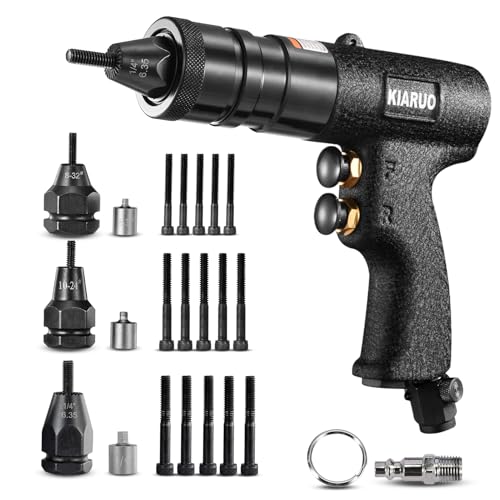
SELF-LOCKING GUN HEAD:Comes with 3 gun heads of different sizes 8-32,10-24,1/4 .The head has a self-locking function that allows you to quickly assemble and disassemble the mandrels without tools,improve work efficiency, convenient and fast
Choosing the Right Replacement Nosepiece for Your Tool and Rivet

Before you replace a nosepiece, know why it matters: a wrong nosepiece can leave rivets loose or damage the tool.
Start by matching the nosepiece diameter to your rivet size and material. Check the rivet chart for the exact diameter — for example, use a 4.0 mm nosepiece for a 4.0 mm aluminium blind rivet — because size and fit determine whether the rivet will seat properly and hold under load. When I fitted a 4.0 mm aluminium rivet on a small aircraft patch, the correct nosepiece stopped the rivet from mushrooming and saved the skin from distortion.
Also confirm material compatibility in one quick step: aluminium, steel, and stainless rivets need different clearances and will wear nosepieces at different rates. Stainless rivets are harder and abrade nosepieces faster; if you frequently set stainless, use hardened or coated nosepieces rated for stainless. I once swapped to hardened aftermarket pieces when doing a stainless railing job; the wear rate dropped from a few hundred rivets per piece to several thousand.
Verify tool fitment before you start. Match threads or quick-change housings so the nosepiece seats securely and won’t loosen during cycles. If your tool uses M6 threaded nosepieces, don’t force an M8; you’ll strip threads. On a scaffolding install I did, matching the quick-change collar kept the nosepiece from coming loose every 50 pulls.
For difficult reaches, consider extensions, but remember they change leverage and may need stronger housings. An extension can add 50–100 mm of reach; that extra leverage increases stress on the housing and fastener, so pick an extension rated for your tool’s pull force. I used a 100 mm extension to reach behind a bulkhead, and switching to a reinforced housing prevented sagging under load.
When replacing, follow these steps:
- Inspect the new nosepiece against the rivet chart and tool thread.
- Install and hand-tighten; test 3–5 rivets in scrap material.
- Check each set for flushness, mandrel break, and tool seating.
- Keep at least one spare nosepiece of each common size on your job.
Do this and you avoid mid-task downtime.
Finally, choose OEM or high-quality aftermarket parts rated for your rivet types, and inspect the fit before work. I keep a labeled pouch with OEM 3.2 mm, 4.0 mm, and 4.8 mm nosepieces on every site because worn parts start showing poor set quality after 500–1,000 stainless rivets.
Recommended Products

【1/4 Inch Heavy Duty Rivet Gun】The reinforced 13-inch-long handles provide maximum leverage for more efficient installation of 1/4" pop rivets, the ergonomic handle design ensures a comfortable riveting experience, and the double-handle design makes the operation even easier.

✅【Upgrade Two-Handed Version】Say goodbye to the pain of using a single-hand riveter. The AKKTOL 13" heavy duty rivet gun, with its two-handled construction, turns a hard job into a very easy one. Its ergonomic design allows you to use it all day without hurting your hands.

Purpose: Specifically designed for the installation of pre-bulbed rivet nuts and other extended rivet nuts Multi-grip
Frequently Asked Questions
Can Worn Nosepieces Affect Rivet Corrosion Resistance Over Time?
Yes — I think worn nosepieces can worsen corrosion resistance by producing poor surface sealing and misaligned, damaged rivet heads that expose metals, increasing galvanic interaction and accelerating corrosion unless you inspect and replace worn parts promptly.
Do Nosepiece Materials Influence Mandrel Collection System Compatibility?
Yes — I consider material compatibility critical: nosepiece Material compatibility and Surface hardness affect mandrel collection system fit and wear; I match hardness to mandrel type to prevent jamming, premature wear, and ensure dependable collection across tools.
How Does Ambient Temperature Impact Nosepiece Wear Rate?
Like weather wearing stone, I’ll tell you: higher ambient humidity and thermal cycling speed corrosion and fatigue, so I’d expect faster nosepiece wear, more frequent inspections, lubrication, and replacements to maintain rivet-setting accuracy.
Can Calibration Tools Quantify Incremental Nosepiece Wear Precisely?
Yes — I can use dimensional metrology tools and wear profiling to quantify incremental nosepiece wear precisely, combining calipers, CMM or optical scanners and periodic profiles to detect micrometer-level changes and trend degradation reliably.
Are Aftermarket Nosepieces Covered by Tool Manufacturer Warranties?
No — I’ve found most manufacturers exclude aftermarket liability, so aftermarket nosepieces typically fall under warranty exclusion; using non-approved parts can void coverage unless the maker explicitly authorizes or certifies those replacements in writing.