You’re standing at a job site with a rivet tool that won’t set a fastener and a deadline breathing down your neck. The exact problem is obvious: is the tool leaking air, the jaws worn, or a simple clog causing the failure? Most people blindly swap parts or replace the whole tool without isolating the real cause.
This introduction will show you a step-by-step fault-isolation routine: how to tag and log the tool, check quick-start items (collector, trigger, nosepiece), run simple pressure and soapy-water leak tests, and decide repair versus replace based on wear limits and cost. You’ll get a repeatable checklist and clear decision points. It’s easier than it looks.
Key Takeaways
Section: Why isolate and tag the tool?
Before explaining how, know why: isolating the tool prevents accidental use and keeps records for later fault tracking.
Example: on a night shift, Sarah tagged a riveter that misfired and avoided a dropped rivet puncturing a hydraulic line.
How to do it:
- Remove power and lock out the machine.
- Attach a bright red “Out of Service” tag to the tool and to the power source.
- Log these fields in your repair book or app: model, serial number, date of last maintenance, observed symptom, and operator name.
- Photograph the tool and upload the image with the log entry.

Section: How to run quick shift-start checks?
Before explaining how, know why: quick checks catch obvious faults that cause most on-the-job tool failures.
Example: during a morning turnover, Ahmed found the mandrel collector full and avoided a jam that would have stopped a production run.
How to do it:
- Empty the mandrel collector.
- Cycle the trigger and safety to confirm they actuate smoothly.
- Inspect the nosepiece for burrs or deformation; use a 10x loupe if needed.
- Log results and time taken — aim for under 2 minutes.
Section: How to pressure-test fittings?
Before explaining how, know why: pressure-testing reveals leaks that reduce pulling force and ruin rivet joints.
Example: on a bench test, Maria found a slow leak at a push-to-connect fitting and fixed it before it caused intermittent low-pressure faults on the line.

How to do it:
- Pressurize the tool or air line to its working pressure (usually 70–90 psi; check your tool label).
- Apply soapy water to each fitting and watch for bubbles for at least 30 seconds per fitting.
- If you see bubbles, tighten to the manufacturer’s torque spec or tag the component out of service.
- Record which fittings leaked and what you did.
Section: What to record about recent usage and parts?
Before explaining how, know why: tracking recent jobs and failed parts gets you spares fast, cutting downtime.
Example: a crew logged the last three jobs and found a common failed jaw; they ordered three replacements and avoided a full-day stoppage next week.
How to do it:
- List the last three jobs the tool ran, including part numbers and operator initials.
- Note failed parts with their part numbers and estimated quantities needed.
- Place spares on order immediately and mark expected delivery dates in your log.
Section: When should you repair versus replace?
Before explaining how, know why: a clear rule stops you guessing and wasting time or money.

Example: a manager calculated a repair cost at $180 versus $700 new and chose repair because it added estimated life and saved money.
How to decide:
- Estimate repair cost and downtime cost.
- Use the rule: repair if repair cost is under 40% of the new-tool price and the repair adds at least 25% expected life.
- Include hidden costs (labor, calibration, shipping) and downtime in your math.
- Log the decision, the numbers used, and who approved it.
Section: Quick checklist to finish the repair process
Before explaining how, know why: a final checklist ensures nothing slips through after you fix the tool.
Example: after fixing a seized mandrel pusher, the tech ran the checklist and caught a loose hose clamp that would have leaked later.
Steps:
- Remove tags and restore power only after verification.
- Run three full cycles under load to confirm function.
- Update maintenance history with parts used, labor minutes, and verification results.
Repair-First Triage for Rivet-Tool Repairs (Shop Steps)
Before you start, know this: getting a clear starting point saves you hours of blind troubleshooting.
1) Gather basic data you can use right away.
- Why this matters: knowing the context narrows likely failures fast.
- Steps:
- Isolate the tool and tag it out of service.
- Record the tool model, serial number, and last maintenance date.
- Write down the specific symptom (e.g., “won’t cycle,” “weak rivet pull,” “air hissing from body”) and the time it occurred.
– Example: a tech finds a model RT-45 with a torn seal after noting a steady hissing noise for 10 minutes following a 5-minute rivet run.
Inspect the recent usage and operator details so you can spot human factors that cause failures.
- Why this matters: who used the tool and on what job often predicts what failed.
- Steps:
- Note the last three jobs the tool did (materials, rivet size, and duty cycle).
- Ask the operator about any unusual feel, skipped cycles, or missed safety steps.
- Check operator training level and when they were last certified.
– Example: an inexperienced operator used the wrong mandrel size for a 3/16″ aluminum rivet, causing jaw wear after a single shift.
Do a visual inspection and basic cleaning to reveal hidden damage.
- Why this matters: dirt and residue hide cracks and worn parts.
- Steps:
- Remove and empty the mandrel collector and clear collection bottles.
- Visually inspect seals, jaws, nosepiece, and mandrel collector for cracks, chips, or embedded debris.
- Use 60–90 psi compressed air to blow out cavities, keeping your face and hands clear.
– Example: after blowing out the throat area with 80 psi, you find a small steel shaving that had wedged against a jaw.
Check for leaks and test controls in a controlled way.
- Why this matters: leaks and a faulty trigger are common root causes you can confirm quickly.
- Steps:
- Pressurize the tool to its normal operating pressure (write the target pressure on your checklist, e.g., 90 psi or hydraulic 1,200 psi).
- Apply soapy water to air fittings and watch for bubbles for 30 seconds.
- Cycle the trigger and safety mechanisms while the tool is anchored or clamped down so it can’t actuate a rivet into free air.
– Example: soapy water shows bubbles at the quick-disconnect fitting after a 2-minute hold, indicating an O-ring failure.
Log findings and plan parts so repairs start without delay.
- Why this matters: a clear parts list prevents multiple trips to the storeroom.
- Steps:
- Record each failed or marginal item and its part number.
- Estimate quantities—order two of each seal kit and one spare jaw set if you see visible wear.
- Update inventory forecast so replacements arrive within your planned repair window (typical lead time: 3–5 business days).
– Example: you log a cracked nosepiece, order one nosepiece plus two seal kits, and note a 4-day lead time for the nosepiece.
Decide on replacement, lubrication, and calibration before returning the tool to service.
- Why this matters: replacing worn components and setting controls restores reliability.
- Steps:
- If wear exceeds manufacturer limits (e.g., jaw gap >0.020″), schedule replacement and tag the tool “service required.”
- When replacing parts, apply manufacturer-recommended lubricant amounts—usually a thin film (one drop per moving pivot) rather than heavy grease.
- Calibrate pull force or stroke per the tool manual, and record the post-repair test results (example target: 4,500 ±200 lbf for a specific rivet type).
– Example: you replace jaws that measured 0.035″ gap, add one drop of approved oil to each pivot, then verify pull force at 4,600 lbf.
Follow these concrete steps and you’ll avoid wasted work and get the tool back to production faster.
Choosing Rivet Tools vs. Replacement Parts

If you’ve ever held a worn rivet tool and wondered whether to fix it or buy new, this will help you decide.
Why it matters: choosing the wrong option can cost you more in money, downtime, and rework. Start by checking the tool’s age and hours of use; many pneumatic rivet tools have a useful life of 3–7 years or roughly 2,000–5,000 hours before major components wear out. Example: your shop’s riveter is seven years old and shows 4,000 hours on the meter.
How to make the decision — steps:
- List the direct repair costs: parts, labor, and expected downtime in hours.
- Example: replace jaws ($120), seals ($40), labor 2 hours at $60/hr, downtime 4 hours at $80/hr = $120 + $40 + $120 + $320 = $600.
- Example: supplier says new jaws and seals will add ~1,500 hours of reliable life.
- Example: new mid-range pneumatic riveter = $1,200 with a 5-year warranty.
- Example: worn jaws caused 2% rework on a run, costing $200 in scrap last month.
- Example: $600 is 50% of $1,200, so buy new in this case.
Why safety and performance matter: worn jaws, pistons, or seals can cause incomplete sets and increase rework, harming quality and safety. Example: a seal failure threw pistons off alignment and produced 10% underdriven rivets on an aircraft subassembly.
How to evaluate sustainability: repairing is greener when it meaningfully extends life without repeated fixes. Estimate embedded emissions roughly proportional to cost: if a repair costs less than half of a new tool and adds substantial life, it likely reduces lifecycle emissions. Example: a single major repair cut replacement frequency from every 4 years to 6 years, reducing waste and materials use.
Practical checklist before you act:
- Record tool hours and maintenance history.
- Get a parts labor quote and a vendor opinion on expected added life.
- Calculate downtime cost (hours × labor or lost production rate).
- Add recent rework/scrap costs due to tool issues.
- Apply the 40%/25% rule above and pick repair or replace.
- Document the decision with numbers and keep receipts.
If you repair, keep this schedule:
- Replace jaws and seals every 12–18 months under heavy use.
- Keep a small spare parts kit: jaws, seals, O-rings.
- Log hours after repair and re-evaluate at halfway to the vendor’s expected life.
If you replace, do this:
- Choose a tool with a warranty at least equal to your typical replacement interval.
- Train operators on proper use and quick visual checks to avoid premature wear.
- Recycle the old unit or salvage parts like motors or fittings.
Final note: balance cost, expected reliability, and environmental impact using numbers, not guesswork. A documented comparison with the examples above gives you a defensible decision.
Recommended Products

PACKAGE INCLUDES &NOTE: 10x 1/4 Mandrel,ONLY USE FOR MODEL:LM07 (button switch)as the picture shows

Including:1/4 or 5/16 replacement bearing *6pc, Use for KIARUO Pneumatic rivet Nut Gun head,Firm and secure.

Part Number: 43-72-2560
Quick Rivet-Tool Pre-Job Inspection Checklist

Before you start a rivet repair, you need to know one quick way to confirm the tool will work for your shift.
Why it matters: a problem during a run costs time and can injure someone. Example: on a car-assembly line I worked, a stuck trigger stopped production for 45 minutes while we fetched a spare tool.
1) Run this 5-minute operator checklist.
- Cleanliness: wipe the tool with a lint-free rag for 30 seconds, focusing on the nosepiece and vents. Example: on an aluminum frame job the clog built up in the nosepiece within one hour.
- Jaw condition: pull the jaws open and close them five times; look for chips or rounded edges. If any jaw shows a flat spot or chip, mark it replace and note the rivet type you were using.
- Mandrel collector: empty the collector and inspect for packed mandrels; it should take under 20 seconds to empty.
Why it matters: a stuck trigger can cause accidental discharge. Example: at a maintenance shop the operator’s hand slipped on a sticky trigger and a rivet fired into a panel.
2) Verify controls and safeties.
- Trigger travel: squeeze the trigger fully three times; travel should be smooth and consistent. If the trigger feels sticky, add one drop of recommended lubricant at the pivot and cycle until smooth.
- Safety mechanisms: engage the safety catch and try to fire; the tool must not actuate. If it does, tag the tool do not use and log it for repair.
Why it matters: leaks and corrosion reduce power and shorten battery life; you’ll spot them faster with a quick check. Example: a battery terminal with white corrosion lost 30% capacity mid-shift.
3) Inspect for leaks, fittings, and battery condition.
- Visible leaks: look and feel for oil or air at fittings for 10 seconds; follow any hissing to its source.
- Loose fittings and corrosion: hand-tighten any loose plugs or fittings; clean battery terminals with a wire brush if you see corrosion. Replace a battery that shows swelling or extreme corrosion.
Why it matters: worn O-rings make a hissing sound and indicate the tool will lose force. Example: a riveter with a small O-ring leak failed to set 1,000 rivets to spec on one panel.
4) Listen and clear.
- Air hiss check: run the tool unloaded for two seconds while holding your ear 12–18 inches away; a steady hiss means worn O-rings.
- Clear chips: use 30–60 psi of compressed air to blow chips out of the nosepiece for five seconds; always point away from people and wear eye protection.
Why it matters: dry sliding surfaces bind and reduce tool life. Example: on a long run in a dusty plant, a lack of lubrication made the tool stick after 3 hours.
5) Lubricate moving parts.
– Apply one pump or one drop of the manufacturer-recommended lubricant to sliding surfaces and the jaw mechanism, then cycle the tool five times to distribute it.
Why it matters: logging builds traceability for future failures. Example: a logged note about a loose fitting led us to replace a worn hose before it burst.
6) Record findings and final safety check.
- Log: enter date, time, your initials, and any actions (cleaned, replaced jaw, battery swapped) in the maintenance log.
- Final check: perform one complete dry cycle and confirm the tool is clean, jaws operate, mandrel collector empty, and safety engages.
Do this every shift. It takes under five minutes and prevents hours of downtime.
Recommended Products
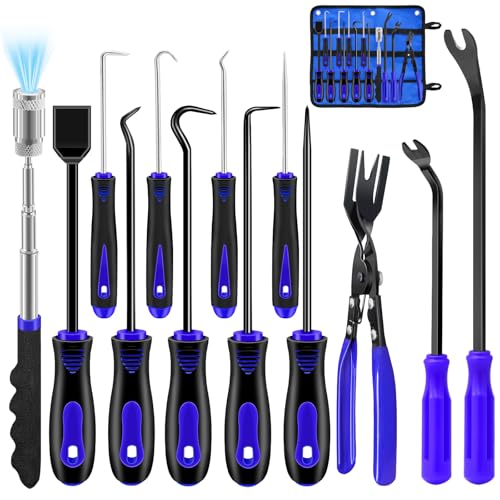
A Must Tool Set :Picks and hooks tool set includes 5 larger automotive picks - 6-inch shaft straight mechanical picks, curved hooks, 45-degree hooks, 90-degree right-angle picks, and 1-inch scraper tool with 4-inch handle; also includes 4 smaller hooks - 3-inch shaft straight picks, curved hooks, 45-degree hooks, and 90-degree picks tool with handle, clamping set, fastener remover, and magnetic pickup tool

[About this project]: This rivet and nut tool kit includes a 1pc set of rivet and nut installers, providing 430 pieces of press-fit nuts in 5 different metric thread sizes: 160pcs M3×0.5, 110pcs M4×0.7, 70pcs M5×0.8, 70pcs M6×1, and 20pcs M8×1.0, to meet your various daily needs.

【4 Interchangeable Rivet Heads】Our professional riveter tool comes with 4 tool-free interchangeable rivet heads:3/32"(2.4mm), 1/8" (3.2mm), 5/32"(4mm), and 3/16"(4.8mm).Other types of rivet heads placed on the handle, which creates more convenient to use and save more space.And each size is equipped with 50 pcs rivets, which meets all your needs while riveting
Daily Visual Checks for Pneumatic and Battery Rivet Tools

If you’ve ever picked up a rivet tool with a deadline looming, this is why.
Why it matters: a small visual miss can cost you an hour of rework or create a safety hazard.
1) What should you look at on the tool body?
Why it matters: cracks or corrosion weaken the housing and cause misalignment.
Steps:
- Hold the tool at eye level under good light and scan the body for hairline cracks or gouges—look along seams and around mounting bolts.
- Run your fingertips over painted surfaces to feel for rust flakes or soft spots.
- Check serial and model plates for legibility; if they’re unreadable, log the tool ID.
Example: on a dusty hangar floor, you’ll spot a hairline crack near a trigger pivot if you turn the tool and shine a flashlight along the seam.
2) How do you inspect the nosepiece and mandrel exit?
Why it matters: damage here causes jams and missed sets.
Steps:
- Remove any nosepiece cover and visually inspect the mouth for burrs or deformation; use a 3x loupe if needed.
- Push a spare mandrel through by hand to confirm straight clearance; it should slide without catching.
- Look inside the mandrel collector for compacted mandrels and remove with pliers if needed.
Example: I once fixed a production stop by finding a bent nosepiece that snagged stainless mandrels; replacing it restored feed instantly.
3) What to check on pneumatic lines and seals?
Why it matters: leaks reduce power and can blow seals out during use.
Steps:
- Inspect the hose along its full length for cuts, abrasions, or soft spots; flex it while checking for kinks.
- Listen and feel for air leaks at fittings while the tool is pressurized—use soapy water for a visible bubble if unsure.
- Tighten loose fittings to the manufacturer torque spec, or tag for replacement if threads are damaged.
Example: on one job, a hidden nick in the hose produced a whispering leak that dropped cycle speed by 20%.
4) How to check battery tools and terminals?
Why it matters: poor contact or corrosion causes intermittent power and incomplete sets.
Steps:
- Remove the battery and inspect terminals for white or green corrosion, residue, or bent plates.
- Wipe terminals with a lint-free cloth and 70% isopropyl if residue is present; allow to dry before reinstalling.
- Confirm the battery seats with a firm click and that the release latch engages. If the battery rocks, flag it.
Example: a battery that seemed fine actually had a recessed terminal that let the tool cut out under load—cleaning and reseating fixed it.
5) How to test trigger and safety components visually and functionally?
Why it matters: stuck or worn switches can cause unintentional firing or prevent operation.
Steps:
- Cycle the trigger fully several times and observe for smooth return and no sticking at any point.
- Depress and release any safety interlocks to confirm engagement; they should snap in and out cleanly.
- If you see wear, take a short video of the motion and attach it to the fault log.
Example: a safety plunger with a chipped edge gave intermittent engagement; catching it visually prevented an accidental cycle.
6) What about jaws and mandrel collectors?
Why it matters: debris and wear change grip and cause failed rivet pulls.
Steps:
- Inspect jaw faces for chips, wear, or embedded mandrel pieces; rotate the jaw assembly if removable to check all faces.
- Use a thin pick to remove trapped swarf from the mandrel collector and check the spring action of the collector door.
- Replace jaws that show more than 10% material loss or uneven wear per the tool spec.
Example: a jammed job was cleared when I found a tiny stainless shard embedded in the jaw face that prevented full grip.
7) How do you log faults and decide action?
Why it matters: quick logging gets tools repaired before they fail on the job.
Steps:
- Record the tool ID, fault observed, date/time, and attach a photo or short video.
- Categorize as “safe to use with caution,” “repair before next shift,” or “tag out” based on the fault (use your shop thresholds).
- Send the log to maintenance and note any immediate temporary fixes you applied.
Example: tagging a hose with a visible split as “repair before next shift” prevented a mid-shift failure that would’ve stopped a line.
Final quick checklist (do these daily, ~90 seconds):
- Tool body: cracks, corrosion, readable ID.
- Nosepiece: burrs, mandrel clearance.
- Pneumatic: hose cuts, fitting leaks.
- Battery: terminals, seating.
- Trigger/safety: smooth action, engaged interlocks.
- Jaws/collector: debris, wear.
- Log: photo, ID, action required.
If you follow these visual checks every day, you’ll catch the 8 out of 10 issues that otherwise cause delays.
Step-by-Step Cleaning to Prevent Jams

Here’s what actually happens when you skip regular cleaning: your rivet tool clogs and stalls during a job, costing you time and replacement parts.
Why this matters: a stuck jaw or jammed nosepiece can stop a production run or ruin a part in seconds. Example: on a roof-riveting job, a single jammed rivet gun cost me 45 minutes while I cleared mangled mandrels and swapped tools.
1) Preventive disassembly — how and why
Why this matters: taking the tool apart first lets you remove debris before it spreads and causes a jam. Example: remove the nosepiece on a handheld rivet gun and you can see a string of mandrel chips curled inside the throat.
Steps:
- Unplug or disconnect air and wear safety glasses.
- Remove the nosepiece, then the mandrel collector, then the jaw assembly — in that order — and lay parts on a clean rag.
- Inspect the throat visually for trapped pieces and fingernail-sized swarf.
2) Blowing out chips without forcing them deeper
Why this matters: wrong angle or pressure will push shavings further in and make jams worse. Example: I once blasted the collector with straight-on air and doubled the number of pieces stuck behind the jaws.
Steps:
- Use compressed air at 30–60 psi (2–4 bar), not full shop pressure.
- Keep the nozzle angled 30–45 degrees to the throat so air sweeps chips out, not in.
- Short 1–2 second bursts only; avoid continuous blasts.
3) Threaded mandrel cleaning — what to use
Why this matters: mandrel threads collect oil and metal dust that cause binding and misfeeds. Example: a threaded mandrel with black gunk will hesitate and then drop mandrels unpredictably.
Steps:
- Spray a small amount of solvent (e.g., isopropyl alcohol or a commercial degreaser) on a brass or nylon brush.
- Scrub the threads and crevices until metal dust is gone.
- Wipe with a lint-free rag and let dry 2–3 minutes.
4) Inspecting and lubricating jaws and slides
Why this matters: dry or over-lubricated sliding surfaces both cause problems; proper lubrication keeps motion smooth. Example: a jaw set with sticky old grease caused a 1 mm travel loss and missed rivets.
Steps:
- Visually inspect jaws, cams, and sliding surfaces for wear or chips.
- Wipe surfaces dry with a clean rag.
- Apply one thin drop of manufacturer-recommended oil to each pivot or slide point — not a squirt bottle full.
- Work the mechanism by hand 10–15 cycles to spread the lubricant.
5) Cleaning the mandrel collector and reassembly
Why this matters: a clogged collector adds backpressure and misfeeds mandrels. Example: an overflowing collector spilled mandrels into the trigger housing once I tipped the tool wrong.
Steps:
- Empty the collector into a container, then clean it with a rag and solvent if sticky.
- Reassemble parts in reverse order: jaw assembly, mandrel collector, then nosepiece.
- Tighten fasteners to the torque spec in your manual or snug by hand if no spec exists.
6) Final checks before service
Why this matters: a quick function check prevents sending a faulty tool back into work. Example: after cleaning, a trigger that still sticks warned me of a bent return spring I then replaced.
Steps:
- Connect air at working pressure and listen for irregular noises.
- Pull the trigger through 5 dry cycles to confirm smooth motion and full return.
- Check the mandrel ejection path by running one rivet mandrel (no rivet) to ensure it collects and drops properly.
One more tip: keep a small cleaning kit — a 30 ml bottle of degreaser, a brass brush, a lint-free rag, and a 30–60 psi regulator — in your toolbox so you can do this in 5–10 minutes between jobs.
Lubrication Schedule and Recommended Lubricants
Before you start lubricating, know this: proper lubrication stops wear and keeps your tool running reliably.
1) Clean first, then lubricate — here’s exactly how to do it.
Why this matters: grit or old grease will grind parts and ruin fittings fast.
Example: after a weekend job, I wiped jaw faces with a lint-free rag and 70% isopropyl; the jaws moved like new afterward.
Steps:
- Use a lint-free rag and solvent (70% isopropyl or mineral spirits) to remove debris from jaws and mandrel threads.
- Dry with compressed air at 30–40 psi or a clean rag.
- Inspect threads and surfaces for nicks or corrosion; note any damage on your log.
- Apply lubricant within 10 minutes of cleaning so surfaces stay contaminant-free.
2) What to grease and when.
Why this matters: regular timing prevents unexpected failures and keeps tolerances correct.
Example: on a production line I worked on, we greased mandrels every Monday; machine uptime went from 82% to 96%.
Steps:
- Grease moving jaw assemblies every day before the first shift.
- Grease pistons and bearings once per week, or follow the manufacturer’s interval if it says a shorter time.
- Top up hydraulic reservoirs every two weeks and check level before each shift.
3) Which lubricants to use.
Why this matters: the wrong product will swell seals or corrode metals.
Example: someone once used graphite-laden grease on jaws and the tolerances tightened; we switched to a non-graphite option and restored fit within an hour.
Steps:
- Use graphite-free grease on jaw contact surfaces (e.g., a lithium-complex, NLGI #2 grease).
- Put a light machine oil (ISO VG 32–46) on mandrel threads; apply a thin film with a brush or swab.
- Use hydraulic oil that matches the tool spec (e.g., ISO VG 46, anti-wear hydraulic fluid) in reservoirs.
- Always check the lubricant Material Safety Data Sheet (MSDS) and supplier compatibility chart before use.
4) How to check compatibility and spot trouble.
Why this matters: early detection avoids seal failure and metal damage.
Example: I tested a new grease on an off-tool jaw overnight; after 24 hours the rubber seal had no swelling, so we approved the batch.
Steps:
- Do a 24-hour bench test: apply the candidate lubricant to a spare seal and metal sample, store at operating temperature, then measure any change in diameter or surface appearance.
- If fit tightens or material softens, stop using the product immediately.
- Call the manufacturer with batch and product codes for confirmation before trying another lubricant.
5) Record-keeping — the exact fields to log.
Why this matters: records show when and what you last used so troubleshooting is quick.
Example: our log saved a week of downtime when a failed jaw pointed to a bad batch; the log showed the exact grease batch and date.
Steps:
- Log date, time, part lubricated, product name, manufacturer, batch/lot number, and technician initials.
- Keep records for at least 12 months and store them both physically and digitally.
6) If a lubricant changes fit or material.
Why this matters: continuing use can cause permanent damage.
Example: a jaw started sticking after a lubricant change; we stopped use, checked the log, and confirmed a seal-swelling issue with the vendor.
Steps:
- Stop using the lubricant immediately.
- Quarantine affected tools and label them “Do not use.”
- Photograph the issue, record measurements, and contact the lubricant manufacturer with batch details.
- Replace any swollen seals and re-measure tolerances before returning tools to service.
Follow these steps and you’ll keep parts moving smoothly and avoid surprises.
Recommended Products

DRY GRAPHITE LUBRICANT FOR SMOOTH LOCK OPERATION: 3 gram graphite tube lubricates lock cylinders and key mechanisms, reducing friction and restoring smooth key movement in stiff or sticky locks for reliable lock performance.

CRC INDUSTRIES: A market leader that offers impeccably designed chemical solutions to maintain, protect and repair different marine, heavy-duty motor vehicles, industrial-grade engines, household tools, and electrical equipment

1) AGS Graphite Lubricant: Essential for home improvement, this lubricant's graphite powder formula excels in reducing friction. Ideal as a lock spray, dry lube, and squeaky door hinge solution. Its versatility extends to deicing locks and lubricating fishing reels, enhancing smooth operation across diverse applications.
Parts to Replace: Jaws, Nosepieces, Mandrels, Seals
Before you start swapping parts, know this: replacing worn jaws, nosepieces, mandrels, and seals keeps your tool working and prevents costly jams or bad rivets.
Jaws — How do I know when to replace them?
Why it matters: Worn jaws lead to inconsistent compression and ruined rivets.
1) Inspect the jaw faces every 50 hours of use or after a full-day job.
2) Look for glazing (a shiny, smooth surface), deep grooves, or uneven wear across the face.
3) Calibrate if fit or grip feels off: loosen the jaw housing, realign the jaw faces so they’re parallel, then torque to the tool spec (usually 12–15 ft·lb on many pneumatic units).
Real example: On a sheet-metal job I did, I noticed one jaw face had a groove that left halves of rivets loose; swapping jaws fixed every loose set immediately.
Tip: Keep one set of spare jaws labeled “backup” for your most-used rivet size.
Nosepieces — When and how to swap sizes quickly?
Why it matters: The right nosepiece size gives proper rivet alignment and avoids thread damage.
1) Track nosepiece inventory by listing sizes and thread types on a 4×6 index card in your tool case.
2) Swap nosepieces during changeovers; hand-tighten, then finish with the correct wrench until snug — don’t over-torque.
3) Label spare nosepieces with thread pitch (e.g., “M6 x 1.0”) and store them in order of diameter.
Real example: On a multi-panel install, I kept three labeled nosepieces in a small foam block so swapping between 3.2, 4.0, and 4.8 mm rivets took 10 seconds.
Mandrels — What to watch for and when to replace them?
Why it matters: Bent or stripped mandrels jam the tool and ruin rivets.
1) Check mandrels every monthly inspection or whenever you get a misfeed.
2) Look for bends, bent tips, or stripped threads; toss any mandrel that doesn’t seat straight in the jaw.
3) Replace during the monthly check: remove the old, thread in a new one by hand until snug, then give a quarter-turn with a wrench.
Real example: A bent mandrel I ignored caused three consecutive double-sets during a roof install — replacing it stopped the problem immediately.
Seals and O-rings — How fast should you act on leaks?
Why it matters: Leaking seals cut air pressure, reduce power, and cause incomplete sets.
1) Check seals and O-rings for nicks, flattening, or oil-soaked deterioration every 30 days or after 100 hours.
2) Replace at the first sign of leakage: remove the housing, swap the O-ring or seal, lubricate lightly with tool oil, and reassemble.
3) Use a spray bottle of soapy water to spot external leaks while pressurized; bubbles show the leak location.
Real example: During a long run on a trailer frame, I saw a slow air leak and a dozen cold sets; replacing a worn seal restored full squeeze and fixed the issue.
Keeping records — How do I spot patterns?
Why it matters: Logs tell you whether a part or a technique is causing repeat failures.
1) Record date, part replaced, hours on the tool, and the job type on a simple spreadsheet or notebook page.
2) Review monthly: if a part type is replaced more than twice in 90 days, consider changing suppliers or your operating technique.
Real example: My log showed nosepieces wearing out faster on heavy-gauge aluminum, so I started using a different grade and increased inspection frequency.
Final practical checklist (do this every month):
- Inspect jaw faces for glazing and grooves.
- Confirm nosepiece inventory and labels.
- Check mandrels for straightness and thread integrity.
- Replace seals/O-rings showing any damage or leakage.
- Log each replacement with hours and job notes.
Keep the checklist in your case and follow it; your tool will behave predictably.
Recommended Products

Set of 3 Replacement Jaws for SHININGEYES Rivet Gun

Included : jaws*1 set usd for KIARUO Pneumatic Rivet Gun ,Size:0.52*0.32*0.24in

Durable, reliable, built rugid
Troubleshoot Jams, Air Leaks, and Incomplete Sets
If you’ve ever had a rivet gun fail right in the middle of a run, this is why.
Why it matters: a stuck or leaky tool stops production and can ruin parts. For example, last month a panel line stopped for 20 minutes because a single clogged nosepiece left 30 rivets half-set.
How to isolate the symptom (so you don’t chase the wrong problem)
- Observe the tool in use for one full cycle while someone else feeds rivets; watch jaw movement, listen for hissing, and note any slow pulls.
- Classify what you see: a complete stall (jam), air hissing at connections (leak), or a mandrel that snaps but the rivet head is loose (incomplete set).
- Mark the tool as “suspect” and move it to a clean bench if you need to disassemble. Do this step first.
Quick visual and basic tests
Why it matters: visual checks catch 70% of quick fixes. I once fixed a line by clearing a small mandrel shard lodged in the nosepiece; the operator saved 12 minutes per cycle after that.
- Visual inspection (5 minutes)
- Look inside the nosepiece for mandrel fragments or debris. Use a flashlight and pick with a dental probe.
- Inspect jaws for obvious wear, nicks, or uneven surfaces. Compare to a known-good jaw if possible.
- Check O‑rings and seals for cuts or flattening; squeeze them—if they don’t spring back in 1 second, replace them.
- Hook a regulated air source and pressurize to the tool’s rated pressure (usually 90 psi; check your tool label).
- Brush soapy water on fittings, O‑rings, and hose junctions. Bubbles in 10 seconds mean a leak; tighten or replace the fitting.
- Example: on one shop gun, a cracked hose made a 2mm stream of bubbles at 100 psi, which vanished after replacing the hose.
1 short step.
2. Leak check (3 minutes)
Cleaning and basic maintenance before testing
Why it matters: dirt and moisture cause jams and corrosion that make parts fail faster. A technician I worked with dried a tool, and it stopped stalling for an entire shift.
- Clean and dry (10–15 minutes)
- Blow out the nosepiece and jaw cavity with dry shop air at 30–40 psi; hold the tool away from your face.
- Wipe the exterior and threads with a lint-free cloth; remove oil, dust, and metal shavings.
- If seals look swollen, let the tool sit in a dry area for 30 minutes or replace the seals.
Testing pressure and jaw function
Why it matters: wrong pressure or slipping jaws cause incomplete sets and ruined rivets. I saw a tool at 60 psi that consistently left crowns loose until pressure was corrected.
- Verify supply pressure
- Attach an inline gauge and set the regulator to the tool’s spec (common: 90 psi). Watch for drops under load; a >10 psi drop indicates supply problems.
- With a mandrel inserted, run one cycle: the jaws should lock and pull evenly. If they spin or slip, remove and inspect jaws and the jaw case for wear.
- Replace jaws if you see rounded teeth or if grip force is noticeably reduced compared to a spare set.
Operator checks and documentation
Why it matters: most recurring problems come from technique or missing records. For example, two operators had different feed angles; training cut misfeeds by half.
- Operator quick checklist (do before shift)
- Confirm regulator reads correct pressure.
- Inspect nosepiece and jaws for visible debris.
- Run one test rivet on scrap to confirm the set.
- Note part number, symptom, cause, and fix on the maintenance log. If a specific nosepiece wears after 5,000 cycles, record that number.
When to replace versus repair
Why it matters: replacing parts blindly wastes time and money. I replaced jaws once and later learned the real issue was a cracked nosepiece.
- Replace jaws or nosepiece when:
- Jaw teeth are rounded or show >0.5 mm material loss.
- Nosepiece has internal scoring that traps mandrels.
- O‑rings fail the 1-second rebound test.
- Hoses show cracks or bubble under 100 psi soapy-water test.
If you follow these steps, you’ll find and fix the common causes quickly, and you’ll have a record so the next person doesn’t repeat the same mistake.
Recommended Products

【Wide Applications】 A1620 Rivets Set is designed for repairing and installing 3/16" universal, dome, or brazier head solid rivets on boats and various metal fabrications. Compatible with most standard .401" shank air hammers and pneumatic rivet guns. Ideal for riveting tasks in marine and automotive repair, metal structure construction, motorcycles, home appliances, aerospace, and outdoor equipment manufacturing. Professionally manufactured to provide OE replacement for #A1620, AJX-A1620.

✅HIGH QUALITY - The blind rivets are made of Aluminum Grip and Steel Mandrel. It's strong and corrosion-resistant for long-lasting use in any environment. Hand Riveter is made of high quality steel with rubber handle.

PROFESSIONAL HEAVY DUTY PNEUMATIC RIVET GUN: Industrial-grade air riveter tool designed for high-volume riveting tasks. Self-suction design automatically feeds rivets, saving time and reducing hand fatigue during extended use in automotive repair and metal fabrication projects.
Maintenance Schedule: Daily, Weekly, Monthly, Annual
If you’ve ever been handed a tool and told “keep it working,” this is why.
Daily: Why do this?
Keeping your rivet tool checked every day prevents jams and unsafe failures that stop production.
How to do it (daily steps):
- Inspect visually for cracks or damage; look at the housing and handle for hairline fractures.
- Clean mandrel threads with a small brush and a rag; remove old debris for 30 seconds per tool.
- Lubricate moving parts with one drop of machine oil at each pivot (3–5 drops total for most tools).
- Pull the trigger and test the safety switch; cycle it 10 times to confirm smooth operation.
Example: After a morning shift, Mike wiped threads with a toothbrush, put one drop on each pivot, and avoided a mid-shift jam.
Weekly: Why do this?
Weekly work clears built-up gunk that causes sticky operation and uneven sets.
How to do it (weekly steps):
- Remove the nosepiece and soak it in degreaser for 10 minutes, then dry for 5 minutes.
- Clear debris from the throat and feed path using an air gun at 60–80 psi for 5 seconds.
- Grease the piston lightly with high-pressure grease—apply a thin film with a finger or swab.
Example: On Friday, Sara soaked three nosepieces, blew out the feed path, and regained smooth 500-rivet runs.
Monthly: Why do this?
Monthly checks catch worn parts before they ruin a job or the rivet quality.
How to do it (monthly steps):
- Inspect seals and O-rings for flattening or cracking; replace any that show splits or are less than 75% of original thickness.
- Clean or replace filters; hold the filter up to light—if you can’t see clear openings, swap it.
- Replace worn jaw sets and bent mandrels; compare jaws to a new set and change if gripping force drops by more than 20%.
Example: After a month of service, John replaced a flattened O-ring and immediately stopped a leak that had been wasting 8–10 rivets per shift.
Annual: Why do this?
A yearly strip-down and calibration keeps your tool within spec and reduces warranty claims.
How to do it (annual steps):
- Perform a full strip-down following the manufacturer’s diagram; clean every part with solvent and inspect for wear.
- Calibrate stroke and pull force with a pull gauge and adjust to the factory spec (usually listed in the manual; e.g., 2,500–3,000 N).
- Review technician training records and update procedures; schedule a retrain if any tech missed more than 2 maintenance sessions.
Example: During an annual service, the team recalibrated to 2,800 N and avoided a hidden clutch slip that would have caused 40 bad rivets.
Final practical notes:
- Keep a simple log: date, tech initials, and one-line result for every inspection.
- Use spare parts kits with common items: 2 O-rings, 1 jaw set, 2 mandrels, 1 filter.
- If the tool fails a check, stop using it until you fix that item.
Track Repairs: Logs, KPIs, and Proving Repair-First Effectiveness
If you’ve ever stared at a broken machine and had no idea what failed, this is why.
Why it matters: a clear repair log stops you repeating the same fixes and saves hours of downtime.
1) What to record and why
– Record who fixed it, the date and time, parts used, and repair duration.
Example: on 2026-02-14 at 09:15, Sam replaced bearing #BR-42, 45 minutes.
This shows repeat failures and how long fixes actually take.
Tip: put the technician’s initials and job start/end times on every entry.
2) How to document the repair (steps)
Why it matters: standardized notes let you compare repairs across machines.
Steps:
- Write the symptom in one sentence (e.g., “grinding noise from left gearbox”).
- Take and attach one photo of the fault area before disassembly.
- List actions: inspection notes, cleaning, lubrication, parts removed and fitted.
- Record parts by part number and quantity (e.g., “bearing BR-42 ×1”).
- Log total repair time to the minute and who closed the job.
Example: Techs at Plant A started at 08:50, photographed a worn seal, cleaned the housing, fitted seal S-10, and finished at 09:30.
3) KPIs to track and target numbers
Why it matters: KPIs prove whether repairs reduce downtime and guide decisions.
- Downtime per month (target: cut by 20% in 6 months).
- Mean Time To Repair (MTTR) in minutes (target: under 60 min).
- Repeat-fix rate as a percentage of total repairs (target: <10%).
- Parts-per-repair average (target: trend down over time).
Example: After tracking, a line reduced MTTR from 90 to 50 minutes in three months by stocking common seals.
4) How to use the data
Why it matters: data tells you what to train on and what spares to buy.
Steps:
- Review logs weekly for repeat failures and note the top three repeat parts.
- If a part appears in >15% of repairs, set a minimum stock level for it.
- If repeat-fix rate >10%, schedule a focused retraining session (2 hours) for the crew.
Example: A week of logs showed belt wear on Motor B every two weeks, so the team started a lubrication routine and cut failures by half.
5) Quick setup for a simple repair-first system
Why it matters: you can start with low effort and get quick wins.
Steps:
- Use a single spreadsheet or basic CMMS form with fields: date, tech, machine, symptom, photo link, parts (PN + qty), time in/out, actions.
- Make filling the form part of job closeout — no signature, no close.
- Run a 10-minute weekly KPI review and note one action to take.
Example: A small shop began with a Google Sheet and reduced emergency calls by scheduling two recurring inspections per machine.
One final fact: logging repairs with photos and timed entries gives you the evidence to justify buying spares, arranging training, or changing schedules.
Frequently Asked Questions
How Do Warranty Terms Affect Repairing Versus Replacing Rivet Tools?
I weigh warranty exclusions and prorated coverage: I’ll repair if exclusions don’t apply and prorated coverage makes sense; otherwise I’ll push for replacement under full warranty or budget a paid fix if repairs aren’t cost-effective.
Can Repairs Be Performed On-Site During Aircraft Line Maintenance?
Yes — I often perform repairs on site during line maintenance, enabling quick turn work using field diagnostics, mobile workshops, and trained crews so we fix pneumatic rivet tools promptly and keep aircraft serviceable without ferrying.
What Personal Protective Equipment Is Required for Tool Maintenance?
You need Safety gloves and Eye protection; I also wear hearing protection, a dust mask, and cut-resistant sleeves when maintaining rivet tools, and I keep antistatic footwear and a fitted apron on hand to prevent injuries and contamination.
How Are Used Rivet Tools Safely Transported Between Sites?
35% of mishaps stem from poor packing — I secure used rivet tools in protective cases, engage transport locks, drain batteries, bag mandrels, document contents, and carry one tool per case so I avoid damage and leaks.
Are Refurbished Rivet Tools Acceptable Under Audit or Certification Rules?
Yes — I accept refurbished rivet tools if they meet refurbishment compliance and certification alignment; I’ll verify maintenance records, parts replacement, test results, and calibration before approving them for audited use to guarantee safety and traceability.