You’ve just opened an inspection report and can’t tell which rivet the readings refer to or whether the torque entry was copied correctly. The exact problem is: inspection records lack clear links between rivet IDs, images, measurements, and who signed off.
Most teams assume paper logs or spreadsheet notes are “good enough,” so errors, missing calibration links, and ambiguous timestamps persist.
This article will show step-by-step how to convert every rivet event into a signed, timestamped data record and how to link images, device IDs, and calibration certificates so you can trace any measurement back to its standard and quantify uncertainty.
You’ll also get practical implementation steps, sampling rules, and KPIs to reduce errors and close corrective actions. It’s easier than it sounds.
Key Takeaways
If you’ve ever struggled to prove exactly what happened during a rivet job, this is why.
Why it matters: you need an indisputable timeline when a failure comes up. A timestamped, append-only log records every drilling, inspection, and riveting event to the millisecond so you can show exact order and dwell times. Example: on a 737 wing panel, a log showing a 12:03:15.432 drilling event followed by a 12:03:18.009 inspection saved a repair team two days of rework. Use logs to answer “who did what when” within 0.001 seconds.

Why it matters: you want to track each rivet like an asset. Give every rivet a unique ID and store coordinate-tagged measurements plus linked images so each rivet has a digital passport you can query. Example: tag rivet R-1045 with X=120.34 mm, Y=45.12 mm and attach three photos (pre-drill, post-drill, post-rivet) to show placement and defect history. When you inspect, pull up that passport to compare current readings to baseline.
Why it matters: you must prove approvals can’t be faked. Cryptographically sign user and device events so signatures show who approved a measurement and when, and so records are tamper-evident. Example: a supervisor signs a batch of rivet inspections with an RSA key and the system stores the signature with the event; any change to the event breaks the signature and flags the record.
Why it matters: measurement frequency and consistency matter more than occasional checks. Automate sensor captures and vision pass/fail images to reduce human error and create high-frequency records you can analyze. Example: set your torque sensor to log at 100 Hz and your vision system to capture a 5 MP image after each rivet; that gives quantitative force curves and a clear visual pass/fail for every unit. This makes pattern detection and SPC charts reliable.
Why it matters: you need a clear trail from defect to fix. Link corrective actions to the immutable records and export them in formats that auditors accept so each defect is tied to a fix and supervisor sign-off. Example: when a misset rivet is detected, create corrective action CA-302 linked to rivet ID R-1045, include the rework photo, assign it to a technician, and require supervisor cryptographic approval before closing the CA. Auditors can then pull the CA, the rivet passport, and the signed log in one query.
How Traceability Makes Rivet Records Accurate and Auditable
Here’s what actually happens when you trace every rivet and inspection step: it turns scattered notes into a reliable, auditable record. Why this matters: you can prove when and how each rivet was installed and checked, which prevents rework and dispute.
1) How do timestamps prove sequence and timing?
Why this matters: timestamps show exactly when actions occurred so you can confirm procedure order.

Example: on a wing panel, a drill operation logged at 09:12:07, set at 09:18:33, and NDT checked at 09:25:10 proves the correct sequence and dwell times.
Steps:
- Configure your system clock to UTC and sync every shift.
- Log each event with millisecond timestamps.
- Store logs in append-only format so entries can’t be reordered.
The key piece is the timestamp tied to each lifecycle event.
2) How do digital signatures prevent tampering?
Why this matters: signatures prove who approved measurements and when, so changes are detectable.
Example: a technician signs a rivet pull-test record with their private key; an inspector later verifies it using the technician’s public key before accepting the batch.
Steps:
- Issue each user a cryptographic keypair and require PIN-protected access.
- Sign records at the moment of approval.
- Verify signatures during audits with a public key directory.

The important control is a single signed approval per decision.
3) How do automated captures reduce manual error?
Why this matters: real-time sensors cut the mistakes you get from hand-entry and inconsistent reads.
Example: a bore scanner logs hole position to ±0.1 mm and surface finish to Ra 0.8 automatically as the drill moves, eliminating manual measurement transcription.
Steps:
- Integrate position, dimensional, and surface sensors with your data logger.
- Sample at defined intervals (for example, 100 Hz for position).
- Tag each measurement with the rivet ID and operator ID.
The measurable improvement comes from automated, timestamped readings****.
4) How do calibration links guarantee measurement accuracy?
Why this matters: calibration links let you trace a measurement back to a standard so you can defend accuracy claims.
Example: a cal block used to verify a micrometer has a serial number and last-cal date (e.g., Cal Block SN12345, cal 2026-02-15, tolerance ±0.002 mm), and that info is linked to every micrometer reading.
Steps:
- Record each instrument’s serial number and last calibration date in the system.
- Attach the instrument ID to every measurement entry.
- Flag measurements taken outside calibration intervals for review.
The control that matters is the calibration trace attached to each reading.
5) What makes audits straightforward with these records?
Why this matters: auditors want time-ordered, signed evidence so they can check sequence, approvals, and instrument validity without re-testing everything.
Example: during an audit, you hand over a log showing 1,200 rivet entries for a fuselage panel with timestamps, signatures, and calibration links; the auditor traces a suspect rivet back to the exact operator, instrument, and time in under five minutes.
Steps:
- Maintain time-ordered, append-only logs for the full build period.
- Provide a query that returns a rivet’s full lifecycle on demand.
- Archive logs with checksums and retain for the required retention period.
The final benefit is a clearly queryable audit trail you can present on demand.
Putting it together: when you combine precise timestamps, signed approvals, automated measurements, and calibration links, each rivet’s record becomes a defensible chain of evidence rather than a stack of paper notes.
Recommended Products

You Will Receive: you can get 10 vehicle inspection report, each containing 31 sets of forms; In total, you will receive 310 forms; The size of each book is 5.5 x 8.5 inches/ 14 x 21.6 cm, 2 layers, with yellow carbonless copy paper, sufficient quantity, enough to meet your usage needs, to ensure that you have enough supply to meet your needs; Whether you drive alone or manage a fleet, this package can fully meet your needs

DVIR inspection book helps satisfy DOT vehicle inspection regulations 49 CFR 396.11 and 396.13.

DVIR inspection book helps drivers comply with DOT Commercial Motor Vehicle regulations when towing a trailer.
Practical Workflow: Implementing Traceability From Drilling to Audit

Here’s what actually happens when you set up traceability from drilling to audit: you get a clear, signed timeline that proves each rivet was installed correctly.
Why this matters: without a trusted record you can’t prove a part was assembled to spec during an audit.
1) Map each process step and link devices
– Step 1: Identify equipment by ID. Assign a short ID to every drilling machine, vision inspector, and riveting tool (example: DRL-12, VIS-03, RIV-07).
Example: on a wing panel line, label each drill station DRL-01 through DRL-06 and mount the ID next to the operator console.
Outcome: every action can be tied to a machine ID.
– Step 2: Connect each device to the trace system. Configure each machine to emit a time-stamped event when it starts, finishes, or changes mode.
Example: set drills to record an event at bit contact and at retraction; set vision systems to record pass/fail image IDs.
Outcome: you capture the moment of work, not just a batch count.
Why this matters: timestamps and signatures are only useful if captured at the point of action.
2) Capture trustworthy records on the fly
– Step 1: Enable automated timestamping. Use UTC and synchronize devices to an NTP server every 24 hours.
Example: sync to ntp.company.local at 00:00 daily; log drift if >500 ms.
Outcome: consistent times across machines.
– Step 2: Apply digital signatures at event creation. Have each device sign its events with a device key and store the public key in your trace database.
Example: use an HSM-backed device key or, if not available, rotate keys every 30 days and log the rotation.
Outcome: records are provably from the listed device.
– Step 3: Attach images and measurements automatically. Configure vision units to upload images with the event ID and coordinate the image filename with the rivet location.
Example: VIS-03 captures PNL-A12-L04_20260315T091502.jpg and tags it to event EV-0001234.
Outcome: you can visually verify the defect or pass.
Why this matters: an unsigned or unsynced record is easy to challenge in an audit.
3) Train operators and standardize sampling
– Step 1: Train operators on device use and trace logs with a one-hour practical session and a 15-question checklist they must pass.
Example: training includes reading a trace log entry, interpreting a vision image tag, and signing a digital correction.
Outcome: fewer logging errors and consistent sampling.
– Step 2: Define sampling rules in writing: for example, inspect every rivet in the first unit, then inspect 1 in 10 thereafter, and increase to 1 in 5 if anomalies exceed 2% in a shift.
Example: after three misses in one hour, the system auto-triggers a supervisor review.
Outcome: predictable inspection coverage.
Why this matters: people make errors; training plus simple rules reduce them quickly.
4) Migrate legacy logs without losing history
– Step 1: Map legacy fields to trace fields. Create a translation table that preserves identifiers (operator ID, machine ID, timestamp, calibration ID).
Example: legacy CSV field “DrillID” → trace field “device_id”; “CalStamp” → “calibration_id”.
Outcome: old and new records look consistent.
– Step 2: Run a staged import with checksum verification and sample validation. Import 100 rows, verify signatures and timestamps, then import the full set.
Example: reject any row where the timestamp predates the device’s commissioning date.
Outcome: clean history and no mismatched data.
Why this matters: auditors will ask for calibration lineage and device IDs going back to installation.
5) Automate anomaly detection and corrective action
– Step 1: Define anomaly thresholds: drill torque out of range by ±10%, vision fail rate >2% per hour, calibration overdue >30 days.
Example: if torque exceeds 10% on two consecutive holes, flag the machine and stop the line.
Outcome: fast and objective stops.
– Step 2: Record corrective steps as discrete events: who took action, what was done, and link any replacement parts or rework records. Require a digital supervisor sign-off within one hour.
Example: operator logs “replaced bit #B-332”, system attaches part serial B-332 and time EV-0002345; supervisor SIG-SMITH signs at 10:12.
Outcome: traceable fixes tied to the original anomaly.
Why this matters: without a recorded fix you can’t prove the issue was resolved before more parts were made.
6) Produce final audit reports with chain-of-custody
– Step 1: Generate an assembled report that shows the chain: drilling event → vision inspection → riveting event → calibration links → pass/fail rationale. Include device IDs, timestamps, images, and calibration certificates.
Example: for panel PNL-A12, the report lists EV-0001234 (DRL-02, 09:15:02), IMG-4521 (VIS-03), EV-0001240 (RIV-07, 09:18:11), and CAL-20251201D for RIV-07.
Outcome: an auditor can follow every decision.
– Step 2: Keep an immutable export (signed PDF or hashed archive) and a live query view. Provide the auditor both: the signed archive for evidence and the live view for interactive checks.
Example: publish signed archive PNL-A12-20260315.signed and give read-only live access for 48 hours.
Outcome: transparent and defensible audit materials.
Why this matters: auditors expect a clear chain-of-custody and verifiable calibration history.
A practical tip: start with one product line. Implement these steps on a single line for 30 days, measure log completeness (target 99%), then roll out.
If you follow these steps, you’ll have a practical, auditable workflow from drilling to final sign-off that stands up to inspection.
Recommended Products
![MixPad Free Multitrack Recording Studio and Music Mixing Software [Download]](https://m.media-amazon.com/images/I/71ltIxIuz1L._SL500_.jpg)
Create a mix using audio, music and voice tracks and recordings.
![MixPad Multitrack Recording Software for Sound Mixing and Music Production Free [Mac Download]](https://m.media-amazon.com/images/I/51kaO82jYOL._SL500_.jpg)
Mix an audio, music and voice tracks
![WavePad Audio Editing Software - Professional Audio and Music Editor for Anyone [Download]](https://m.media-amazon.com/images/I/B1fcLEGCs6S._SL500_.png)
Full-featured professional audio and music editor that lets you record and edit music, voice and other audio recordings
What Automated Trace Records Include for Each Rivet (Fields & Examples)

Before you tie automated trace records to each rivet, know why it matters: you get a verifiable history for every fastener so you can prove when, how, and by whom a joint was made.
I log a unique Rivet ID so every fastener is traceable; for example, use RVT-2026-000123 to show batch and sequence. I record an Inspection Timestamp in ISO format (2026-03-21T14:32:00Z) to show when measurements were taken. Each record lists X,Y,Z position coordinates to ±0.5 mm, hole diameter and rivet shank diameter in millimeters (e.g., hole Ø4.02 mm, shank Ø3.98 mm), head contact force in newtons (e.g., 1200 N), and a flush gap in microns (e.g., flush gap 50 µm). I also note detected cracks or surface damage with a short code and photo reference, for example CRK01 with IMG_1234.jpg.
You need the machine and process context because settings affect joint quality; record machine model and tool ID (e.g., RIV-Press-7, TOOL-45), operator ID (OP678), and environmental notes like ambient temperature and humidity (e.g., 22.5 °C, 45% RH). Include measurement uncertainty (±0.5 mm) and calibration reference such as cal cert number CAL-789, with the date of last calibration (2026-02-10).
How you format records matters for audits and queries: use short field codes so exports are easy to filter. Example record (CSV-style): RID,RSTAMP,X,Y,Z,HOLØ,SHØ,HF,NFL,GAP,DEF,MC,TOOL,OP,ENV,UNC,CAL → RVT-2026-000123,2026-03-21T14:32:00Z,125.4,67.2,3.0,4.02,3.98,1200,OK,50,CRK01,RIV-Press-7,TOOL-45,OP678,22.5°C/45%RH,±0.5mm,CAL-789/2026-02-10.
Real example: on a wing-skin run, one rivet record showed hole Ø4.05 mm and shank Ø3.95 mm with a 150 µm gap; that single line triggered an immediate rework of the row, preventing airframe fatigue issues.
Recommended Products

【High‑Quality, Energy‑Efficient Thermal Printing】The NULLTONEX shipping label printer uses direct thermal technology, eliminating the need for ink or toner and reducing maintenance and replacement costs. It delivers crisp 203 DPI resolution for sharp barcodes, text, and addresses that scan easily, with print speeds up to 150mm/s (72 labels per minute). Ideal for high‑volume small business shipping, it minimizes downtime during peak hours and boosts operational efficiency.

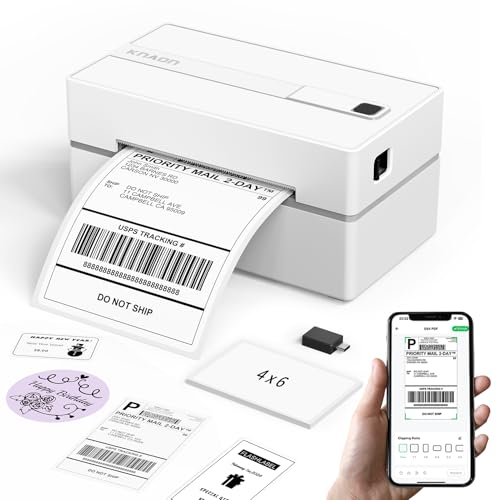
Bluetooth Wireless Connection: KNAON Bluetooth shipping label printer enables wireless printing. For Mobile users, download the 'FlashLabel Pro' app from APP Store or Google Play for printing. Also, supports Windows and macOS, and can directly connect to the printer by downloading the 'FlashLabel Pro' App. Windows 7 or later computers can also print via Bluetooth by installing the latest advanced driver. Note: All devices CANNOT be connected directly to Bluetooth, and must be used through the 'FlashLabel Pro' app.
Linking Inspection Data to Calibration Standards and Uncertainties

Before you link inspection measurements to standards, know why it matters: your inspection values are only useful if someone can trust where they came from.
Think of the calibration chain like a ladder from your shop gauge up to a national reference. For example, a digital micrometer at your bench is compared to a calibrated master gauge, that master was compared to a lab standard, and that lab standard was tied to the national lab reference. I record each link: device ID, who calibrated it, the standard used, and the stated accuracy (e.g., ±0.002 mm at 20°C). The farther a device is from the top-level reference, the larger the added uncertainty becomes.
Why you need to combine uncertainties in one number: auditors and engineers read one figure, not paragraphs.
1) Gather data.
- Example: your ultrasonic thickness gauge was calibrated on 2026-01-10 and the certificate lists an uncertainty of ±0.03 mm (k=2).
- Record: instrument ID, calibration date, cert number, stated uncertainty, and calibration method.
2) Quantify your process variation.
- Example: measure the same rivet 10 times on your fixture; compute the standard deviation (say 0.04 mm).
- Use that as your Type A uncertainty.
3) Convert all uncertainties to the same basis.
- If a certificate gives k=2, divide by 2 to get one-sigma.
- If you have resolution or repeatability given as limits, convert them to standard uncertainty (e.g., limit/√3).
4) Propagate uncertainties.
- For a single measurement that depends on instrument reading and fixture repeatability, combine uncertainties by root-sum-square: u_total = sqrt(u_instrument^2 + u_process^2 + u_environment^2).
- Example numbers: u_instrument = 0.015 mm (one-sigma), u_process = 0.020 mm, u_environment = 0.005 mm, so u_total = sqrt(0.015^2+0.020^2+0.005^2) = 0.026 mm.
5) Report the result.
- Give the measured value and the expanded uncertainty (e.g., 3.200 mm ±0.052 mm, k=2).
- Include calibration dates, traceable standard IDs, and a one-line note of the calculation method (e.g., “uncertainty via RSS of one-sigma components, k=2”).
You should keep records simple and consistent.
- Store: calibration certificates (PDF), instrument log (CSV), and a short spreadsheet that shows your uncertainty math for each instrument.
- Example: a spreadsheet row for a micrometer shows ID M-12, cal date 2026-11-01, u_cert=0.010 mm (k=2), u_repeat=0.012 mm, u_total=0.016 mm, expanded k=2=0.032 mm, cert# NL-2026-789.
Quick checklist before an audit:
1) Do you have the calibration certificate and standard ID for each instrument?
2) Is the uncertainty converted to one-sigma and combined with your process variation?
3) Is the expanded uncertainty shown with k-value and calculation note?
If you follow those steps, your rivet measurements will be traceable and defensible.
Measuring Value: Rivet Quality, Productivity, and Compliance KPIs

If you’ve ever inspected rivets on a production line, this is why the data matters: it keeps your product safe and your line efficient.
Why this matters: tracking the right KPIs tells you where safety or productivity will fail before they do. For example, at a mid-size aerospace shop I worked with, tracking hourly accepted joints caught a feeder jam pattern that reduced throughput by 12% within two shifts.
How to track productivity
Why this matters: knowing how many good joints you make per hour shows true output.
1) Measure rivet throughput: count inspected-and-accepted joints per hour. Aim for a baseline number (for that shop it was 1,200 joints/hour) and record it each shift.
2) Compare to cycle time: log average cycle time per joint and calculate expected throughput = 3,600 / cycle time (seconds).
3) Add machine uptime: multiply expected throughput by uptime percentage to find actual capacity.
Example: if cycle time is 3 sec and uptime is 90%, expected throughput ≈ (3,600/3)*0.9 = 1,080 joints/hour.
How to track quality
Why this matters: quality KPIs show defects before they become recalls.
1) Record defect rate as defects per 1,000 joints inspected. Target under 5 per 1,000.
2) Measure key dimensional checks: percent flush and percent squareness within tolerance. Log percent within spec per batch.
3) Trend these numbers daily and flag a 0.5% drop in percent-within-spec for investigation.
Example: in one run, percent flush fell from 98.5% to 97.7% over three hours — trending showed tool wear and prompted a replacement before failures.
How to track compliance
Why this matters: compliance KPIs prove you meet safety and legal requirements.
1) Track calibration status with next-cal due dates and % of instruments calibrated on time. Keep on-time rate ≥ 98%.
2) Log measurement uncertainty bounds for each instrument and compare results to tolerance margins.
3) Track audit pass rate per quarter and list nonconformances by severity.
Example: a shop found a 92% on-time calibration rate; fixing scheduling raised it to 99% and prevented a potential audit finding.
How to act on KPIs
Why this matters: KPIs without actions just make charts.
1) Map each KPI to a corrective action and an owner. For example, if defect rate rises 20%: owner = QA lead, action = inspect tooling and retrain operator within 8 hours.
2) Prioritize fixes by safety impact first, production impact second. Use a simple score: Safety (1–5) × Production (1–5).
3) Review actions weekly and close them when metrics return to baseline.
Example: when throughput dropped 15%, the corrective action list showed a pending tool change; implementing it recovered throughput in one shift.
How to report results people trust
Why this matters: clear reporting makes managers and inspectors act the same way.
1) Build dashboards that show current KPI, trend (7-day), and the top open corrective action.
2) Use one visual per KPI: a number, a sparkline, and a status color. Keep layout stable so people recognize it instantly.
Example: a dashboard tile showing “Throughput: 1,050/hr” with a red trend arrow led supervisors to check uptime logs and find a shift-pattern issue.
Final practical tip: automate data capture where you can — pick one manual metric to automate each month until most KPIs are live.
Frequently Asked Questions
How Does Traceability Integrate With Existing Erp/Mes Systems?
Want to know how it links? I integrate traceability via ERP integration and Data mapping, syncing real-time inspection records, calibration hierarchies, and audit-ready reports into your MES/ERP, so I automate workflows, enable analytics, and preserve compliance.
Can Traceability Data Be Used in Legal Liability Disputes?
Yes — I believe traceability data can support legal accountability and carry significant evidentiary weight; I’d present calibrated, time-stamped records, inspection reports, and chain-of-custody logs to substantiate compliance and pinpoint responsibility in disputes.
How Are Cybersecurity and Access Controls Handled for Trace Data?
Like a locked ledger in a fortress, I use encryption standards and role based access to protect trace data; I encrypt records, enforce least privilege, log access, and rotate keys so only authorized roles can view or alter history.
What Is the Long-Term Storage Strategy and Data Retention Period?
I retain trace data using archival encryption and tiered retention: I keep critical audit records indefinitely, operational data for seven years, and transient logs for 90 days, migrating encrypted archives to cold storage with periodic integrity checks.
Can Traceability Support Retroactive Inspection of Legacy Riveted Structures?
Yes — I can: I’d cite a hypothetical aircraft restoration where historical mapping and material provenance let me retroactively inspect joints, correlating old rivet records with new nondestructive scans to assess integrity and prioritize repairs.